
Competitive matches in CS2 follow a predictable pattern. The rank system operates on a bell curve—most players are concentrated in the middle tiers, while very few occupy the lowest or highest ranks.
The average player typically lands in the Gold Nova to Master Guardian range. This bracket represents the majority of the player base.
Understanding the CS2 Player Landscape
The CS2 competitive scene is divided into two primary ranking systems: the traditional Competitive mode with its 18 skill groups, and the newer Premier mode, which uses a numerical CS Rating. Both systems measure skill, but they function differently.
Premier mode is now the primary indicator of skill for serious players. The traditional Competitive ranks are now specific to each map.
Understanding your position within this player base provides a realistic assessment of your skill level, helps set achievable goals, and clarifies match difficulty variance.
Premier Rating Distribution
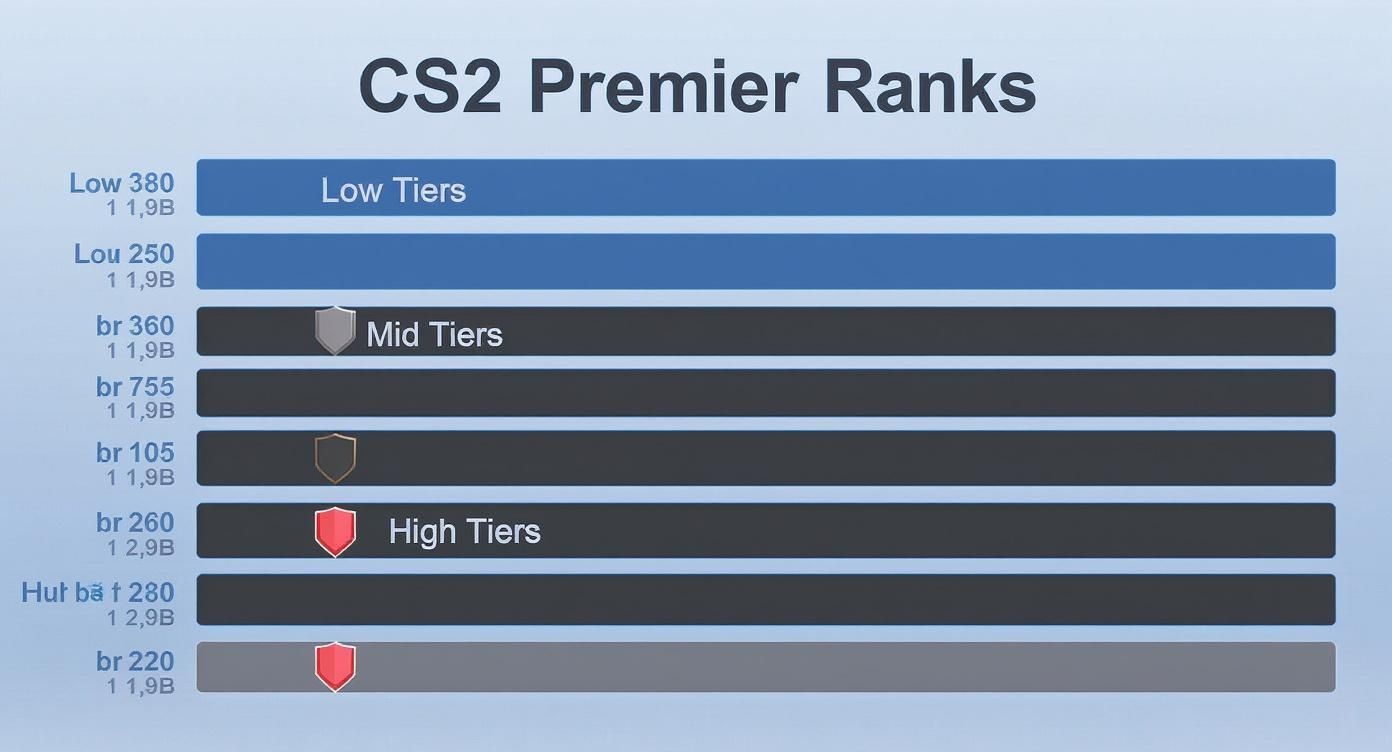
The Premier mode's CS Rating is the current standard for measuring skill in CS2. The breakdown is direct:
- Low Tiers (0 – 4,999): This is where new players begin.
- Mid Tiers (5,000 – 14,999): This is the core of the player base where matchmaking is most active.
- High Tiers (15,000+): This tier contains the most dedicated and skilled players.
Roughly 68% of all active players fall within the 5,000 to 15,000 CS Rating range. The highest concentration is in the Light Blue (5,000–9,999) and Blue (10,000–14,999) tiers, which hold about 35% and 28% of players, respectively.
Surpassing a 25,000 CS Rating is a significant achievement, reached by less than 0.1% of players.
CS2 Rank Tiers at a Glance
This table provides a simplified breakdown of player distribution across skill groups.
| Rank Group | Equivalent CS Rating (Approx.) | Player Base Percentage |
|---|---|---|
| Elite | 20,000+ | Top 1-2% |
| High Skill | 15,000 – 19,999 | ~15% |
| Average | 5,000 – 14,999 | ~60-70% |
| Below Average | 1,000 – 4,999 | ~15% |
The data confirms the high concentration of players in the middle ranks. Advancing into the "High Skill" and "Elite" brackets signifies outperforming the vast majority of the community.
Key Takeaway: The CS2 ranking system is designed to increase in difficulty with each tier. Progressing from Gold Nova to Master Guardian is common, but advancing from Legendary Eagle to Global Elite involves competing against a small, highly skilled fraction of the player base. The system rewards consistency and mastery. To see how professionals perform, our guide on CS2 live scores tracks their performance in real-time.
This bell curve structure is fundamental to CS2's matchmaking. It ensures most matches are against players of a similar skill level, maintaining a fair and competitive environment.
A Detailed Breakdown of Competitive Ranks
CS2's classic Competitive mode uses a system of 18 skill groups, from Silver I to The Global Elite. This system functions as a ladder where each rank reflects increasing skill, game sense, and tactical knowledge. Understanding your position on this ladder is essential to contextualizing your place in the CS2 player base.
The journey begins in the Silver tiers, the proving ground for new players mastering fundamentals like aiming, movement, and map callouts. A significant portion of the community resides in these ranks, learning the game's core mechanics.
The Heavily Populated Mid-Tiers
Advancing from Silver leads to the Gold Nova and Master Guardian ranks. These tiers represent the heart of the CS2 player base and contain the statistically "average" player. Players here have moved beyond basics and are developing consistency, effective utility usage, and sharper tactical awareness.
Progressing through Gold Nova and into Master Guardian indicates a solid grasp of game strategy. Players in this bracket understand team economy management, basic site executions, and team coordination. The majority of matchmaking games occur here, creating the most active and diverse gameplay experience.
Statistical Distribution Across Tiers
The player base is not distributed evenly across the 18 ranks. The population is lower at the bottom, peaks in the middle, and becomes extremely sparse at the top, forming a steep pyramid where climbing becomes progressively more difficult.
The following table details the percentage of players within each skill group.
Complete CS2 Competitive Rank Distribution Percentages
This table shows the specific percentage of the player base occupying each of the 18 competitive skill groups.
| Rank Icon | Rank Name | Player Percentage |
|---|---|---|
 |
Silver I | 3.9% |
|
|
Silver II | 4.3% |
|
|
Silver III | 4.7% |
|
|
Silver IV | 5.2% |
|
|
Silver Elite | 6.1% |
|
|
Silver Elite Master | 7.4% |
|
|
Gold Nova I | 8.7% |
|
|
Gold Nova II | 9.0% |
|
|
Gold Nova III | 8.8% |
|
|
Gold Nova Master | 8.2% |
|
|
Master Guardian I | 7.5% |
|
|
Master Guardian II | 6.6% |
|
|
Master Guardian Elite | 5.4% |
|
|
Distinguished Master Guardian | 4.2% |
|
|
Legendary Eagle | 3.2% |
|
|
Legendary Eagle Master | 2.6% |
|
|
Supreme Master First Class | 1.9% |
|
|
The Global Elite | 0.75% |
The data forms a classic bell curve that peaks around Gold Nova II. To learn more about the full rank findings, you can review more in-depth player statistics.
The chart below illustrates a similar distribution for CS2's Premier rating tiers, which follows the same pattern as the competitive skill groups.
This visual reinforces the data: most players are concentrated in the middle, making the ascent to higher ranks a significant challenge against a progressively smaller talent pool.
The Elite and Upper Echelons
Reaching Legendary Eagle or higher places you in the skilled minority. At this level, high mechanical skill is a prerequisite. Victories are determined by advanced strategies, precise utility usage, and smooth team coordination. Players here understand the game's deepest mechanics and its evolving meta.
Key Insight: The difficulty of climbing increases exponentially past the Master Guardian ranks. Each subsequent rank represents a smaller and more skilled segment of the player base. The competition is more intense, and advancement requires significant dedication.
The final two ranks are Supreme Master First Class (SMFC) and The Global Elite (GE), reserved for the top tier of players. Achieving Global Elite means you are statistically among the best players in the world, a title held by less than 1% of the entire CS2 community. This rank signifies near-perfect mechanics, professional-level game sense, and consistent performance.
Dissecting the Premier Mode CS Rating System
Premier mode is the center of competitive CS2. It replaces the old skill groups with a transparent, number-based CS Rating system. Functioning like a traditional ELO system, every win and loss directly impacts your rating, offering a clear measure of your standing.
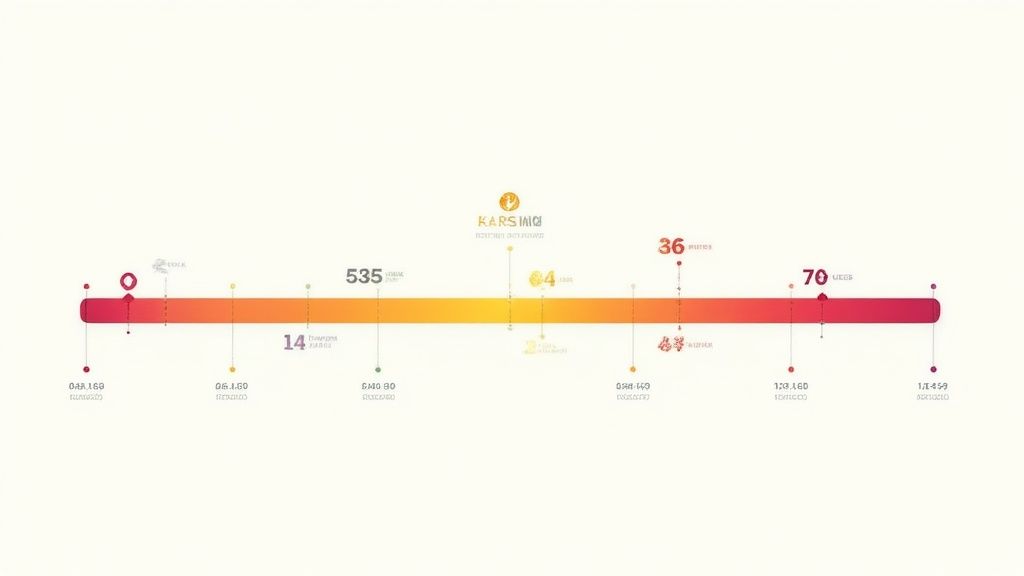
The rating spectrum is divided into seven distinct, color-coded tiers. These colors provide a quick visual indicator of skill level and help in assessing competition. Each color represents a significant milestone in the competitive ladder.
Understanding the Color Tiers
Your rating badge's color directly reflects your skill bracket. This system gives every player clear objectives as they ascend the leaderboards.
The tiers are structured as follows:
- Grey (0 – 4,999): The starting point for all players. It is the proving ground for those new to competitive CS2 or still learning core mechanics.
- Light Blue (5,000 – 9,999): This range contains the majority of players who have mastered the basics and are now focusing on consistency.
- Blue (10,000 – 14,999): Solid, above-average players are found here. They possess reliable aim, good game sense, and a functional knowledge of team strategy.
- Purple (15,000 – 19,999): This is where competition intensifies. Players in this bracket employ advanced tactics and consistently deliver high-impact performances.
Advancing into the upper ranks of Premier mode requires significant dedication and places a player in a small minority of the global population.
The Elite Tiers Explained
The final three tiers are where the game's top players compete. The player population in these brackets decreases dramatically, highlighting the difficulty of reaching and maintaining a position at the top of the CS2 rank distribution.
- Pink (20,000 – 24,999): This tier marks the transition from highly skilled to elite. Mechanics are nearly flawless, and deep strategic thinking is mandatory.
- Red (25,000 – 29,999): Reserved for the best players. These individuals top the global leaderboards and possess a professional-level understanding of the game.
- Gold (30,000+): The absolute peak. This is an exclusive group for the world's top talent, comprising less than 0.1% of the entire community.
Key Takeaway: While reaching the Blue and Purple tiers is a significant accomplishment, breaking into the Pink, Red, or Gold tiers places you in the top percentile of all CS2 players globally. Each new color demands a higher level of skill and consistency.
Statistical Breakdown of Player Distribution
Community-tracked data provides a clear picture of player placement. Community rating datasets indicate, approximately 68% of the player base is concentrated between a 5,000 and 14,999 CS Rating (the Light Blue and Blue tiers). This is the statistical bell curve where the majority of games occur.
Beyond the 15,000 mark, the player count diminishes rapidly. The Purple tier (15,000-19,999) holds about 12% of players. The Pink tier contains just 1.6%, and the Red and Gold tiers combined represent a small fraction of a percent, emphasizing their exclusivity.
This distribution helps players contextualize their own rank and set realistic goals. For those looking to profit from their skills, climbing the ranks can improve opportunities on platforms listed in our guide to the best CS2 trading sites.
Factors Driving Shifts in Rank Distribution
The CS2 rank distribution is a dynamic system, not a static leaderboard. Several key factors influence the player base, ensuring the matchmaking scene remains competitive and balanced over time, preventing rank inflation or deflation.
The primary driver of these shifts is Valve's direct intervention. Periodically, the developers recalibrate ranks across the entire player base to realign the bell curve. If too many players become concentrated in a few tiers, an update can adjust the underlying algorithm to achieve a more natural distribution.
The Impact of Recalibration
A major recalibration occurred when Valve altered the requirements for obtaining an initial rank. This change addressed a long-standing issue where a large portion of the player base was bottlenecked in the Silver tiers, impeding upward mobility.
Recent matchmaking adjustments reduced the number of wins needed for a rank, which elevated a significant portion of the player base. The previously overcrowded Silver ranks became less populated as players advanced to Gold Nova and Master Guardian, while the top ranks remained exclusive. This single update reshaped the competitive landscape.
Other Influential Factors
Besides major updates from Valve, other factors create smaller but noticeable effects on the CS2 ranks distribution.
- Seasonal Player Activity: The CS2 player count varies throughout the year. Major holidays, summer breaks, and the release of other major games can cause temporary fluctuations in player numbers, affecting the percentile calculations for each rank.
- Major Ban Waves: When Valve executes a large VAC (Valve Anti-Cheat) ban wave, thousands of cheaters are removed from matchmaking. As many of these accounts occupy higher ranks, their removal creates a vacuum that allows legitimate players to advance.
- Gameplay and Map Pool Updates: The introduction of new maps or overhauls of existing ones can disrupt the meta. Players who adapt quickly may see their rank increase, while those who do not may decline. Weapon balance patches have a similar effect.
Key Insight: A player's rank reflects their standing within a dynamic and constantly changing scene. A sudden change in rank may be due less to recent match performance and more to a system-wide recalibration by Valve.
Understanding these external forces provides key context for your competitive journey. Mastering game settings is also a key advantage; our guide on CS2 console commands provides the necessary tools for optimization. The ranking system is designed to adapt, ensuring a player's rank is always a meaningful measure of their current skill.
What Your Rank Really Says About You
Your CS2 rank is more than a symbol; it is a snapshot of your current habits, game sense, and mechanical skill. Understanding the implications of your position in the CS2 rank distribution is the first step toward identifying weaknesses and improving.
Each rank group represents a stage in a player's development. By recognizing the common characteristics of each tier, you can set realistic goals and identify the specific skills needed to advance.
Silver Tiers: Building the Foundation
Players in Silver are learning the fundamentals of CS2. The primary focus is on raw mechanics, such as basic crosshair placement, spray control, and map navigation.
Most players at this level are memorizing callouts and learning basic economic principles, such as when to buy or save. Decision-making is often reactive, and team strategy or utility usage is secondary to winning individual aim duels.
Gold Nova Tiers: The Grind for Consistency
The Gold Nova ranks contain the largest segment of the CS2 player base, representing the "average" player. Players here have mastered the basics but struggle with consistency. Performance can vary significantly between rounds.
This is where tactical gameplay begins to emerge. Players use smokes to block angles and flashes to enter sites, though execution may be imperfect. The main challenge in Gold Nova is to make good plays more frequently and develop a reliable skill set.
Key Takeaway: The average Gold Nova player understands what to do in most situations but cannot always execute it effectively. Closing this gap requires dedicated practice on utility lineups and holding angles without impatience.
Master Guardian Tiers: It Starts to Click
Reaching the Master Guardian ranks is a significant achievement. It signifies a move beyond raw aim toward a deeper understanding of CS2's strategic elements. Players here possess dependable mechanics, manage their economy effectively, and communicate to execute plays.
At this level, players think ahead, anticipating enemy rotations and coordinating with teammates for site takes and retakes. While aim is solid, small positioning errors or poor judgment are quickly punished. Individual skill must blend with cohesive team play.
Legendary Eagle and Beyond: The Elite Strategists
Once a player reaches Legendary Eagle, they are in the top tier of the CS2 rank distribution. At this level, strong aim is expected. Games are won or lost based on superior strategy, precise communication, and strong mental fortitude.
These players have mastered advanced concepts like effective mid-round calling, complex utility combinations, and exploiting narrow timing windows. Opponents are unforgiving and capitalize on any mistake. The gameplay is faster, coordination is tighter, and success depends on consistently out-thinking the opposition.
How to Actually Improve Your CS2 Rank
Understanding your position in the CS2 rank distribution is one part of the equation; climbing it requires dedicated effort. Ranking up involves sharpening the specific skills that win rounds, focusing on fundamental habits that separate tiers.

Simply playing more matches is insufficient for progress. Purposeful practice is required. This involves building a routine focused on the core pillars of aim, game sense, and teamwork.
Master Your Aim and Mechanics
Mechanical skill is the foundation of CS2. Strategy is ineffective without the ability to win duels. A daily warm-up and practice routine is the fastest way to build the necessary muscle memory and confidence.
A solid routine includes:
- Aim Training Maps: Use community maps like Aim Botz or Yprac to practice flicks, tracking, and spray control. A 15-20 minute session before the first match activates reflexes.
- Deathmatch Servers: Participate in FFA (Free-For-All) deathmatch to practice crosshair placement and engage targets from various angles under pressure.
- Viewmodel Optimization: Do not overlook settings. A well-configured viewmodel can clear screen space and improve visibility. Our guide on CS2 viewmodel commands explains how to customize it for optimal performance.
Consistent practice ensures that your aim is reliable when strategic opportunities arise. This skill is the bedrock of all other abilities.
Develop Superior Game Sense Through VOD Review
Game sense distinguishes good players from great ones. It involves understanding timings, predicting enemy movements, and making correct mid-round decisions. Reviewing your own VODs (Video on Demand) is the most effective way to train this skill.
Key Insight: Your losses provide the most valuable learning opportunities. Analyze rounds to identify the critical moment of failure, a poor rotation, an unnecessary peek, or wasted utility. Determine a better course of action to avoid repeating the mistake.
Ask these questions during review:
- Was my positioning optimal for the situation?
- Did my utility usage create a tangible advantage?
- Why did I die, and how could I have played differently to survive?
This process transforms past errors into future strengths and sharpens in-game decision-making.
Enhance Communication and Teamwork
CS2 is a team-based game. Five coordinated players will almost always defeat five individuals. Clear, concise, and useful communication is a force multiplier that can decide the outcome of a match.
Incorporate these communication habits:
- Provide Essential Info: Call out enemy positions, numbers, and utility used. Avoid unnecessary chatter.
- Suggest Strategies: Propose simple plans instead of issuing commands. "Let's smoke CT and hit A" is more effective than "GO A!" and encourages collaboration.
- Master the Economy: Monitor your team's finances. Make clear calls for force-buys, ecos, or full buys to ensure the team buys cohesively.
Ranking up requires being a better teammate. A player who enables team success with good communication is more valuable than a silent fragger, leading to a higher win rate and a faster ascent through the CS2 rank distribution.
CS2 Ranks: Your Questions Answered
This section provides straightforward answers to common questions about the CS2 ranking system and matchmaking.
What Is the Average Rank in CS2?
A: The majority of the player base is concentrated between Gold Nova III and Master Guardian I. In the Premier system, this corresponds to a CS Rating of approximately 9,000. This range represents the statistical average, where players have a solid grasp of game basics but need to improve strategy and consistency.
Is The Global Elite Still the Hardest Rank to Achieve?
A: Yes, The Global Elite remains the highest rank in Competitive mode, held by less than 1% of players. In Premier mode, the equivalent is the Red (25,000+) or Gold (30,000+) CS Rating tiers, which are even more exclusive, representing approximately 0.1% of the player base.
How Do I Get My Initial Rank in CS2?
A: To receive a rank in standard Competitive mode, you must secure 10 wins on a specific map. For Premier mode, you must also win 10 matches to be assigned your initial CS Rating. Performance in these placement matches is critical for determining your starting position in the CS2 ranks distribution.
Why Did My Rank Suddenly Change After an Update?
A: Valve occasionally recalibrates the entire ranking system to maintain matchmaking balance and a healthy "bell curve" distribution. If ranks become overly concentrated, an update will adjust player ratings system-wide. This means your rank can change without you playing a match, as it reflects a rebalancing of the player scene.
Does My CS2 Rank Affect My Skin Drops?
A: No, your Competitive rank or CS Rating does not influence skin drops. Weekly drops are determined by playtime and a weekly reset, not by skill level. To obtain a specific skin, purchasing it from a marketplace is the only guaranteed method. For safe platforms, see our guide to the best CS2 trading sites.