The probability of unboxing a knife was once speculative. In 2017, to comply with Chinese regulations, Valve published the official drop rates for CSGO cases. These same odds now govern the skin economy in CS2.
The key statistic is the chance of unboxing an Exceedingly Rare item, such as a knife or gloves, which is 0.26%. This equates to approximately one such item for every 385 cases opened.
Understanding the Official Case Drop Rates
Valve's disclosure provided the community with concrete data. It confirmed that the system uses a steep rarity curve, where each tier is approximately five times rarer than the preceding one.
This structure means Mil-Spec (blue) skins are the most frequent drop, appearing in nearly 80% of all case openings. For a detailed analysis of the original announcement, CSGOSkins.gg has a great breakdown of Valve's numbers.
This chart visualizes the drop rate percentages.
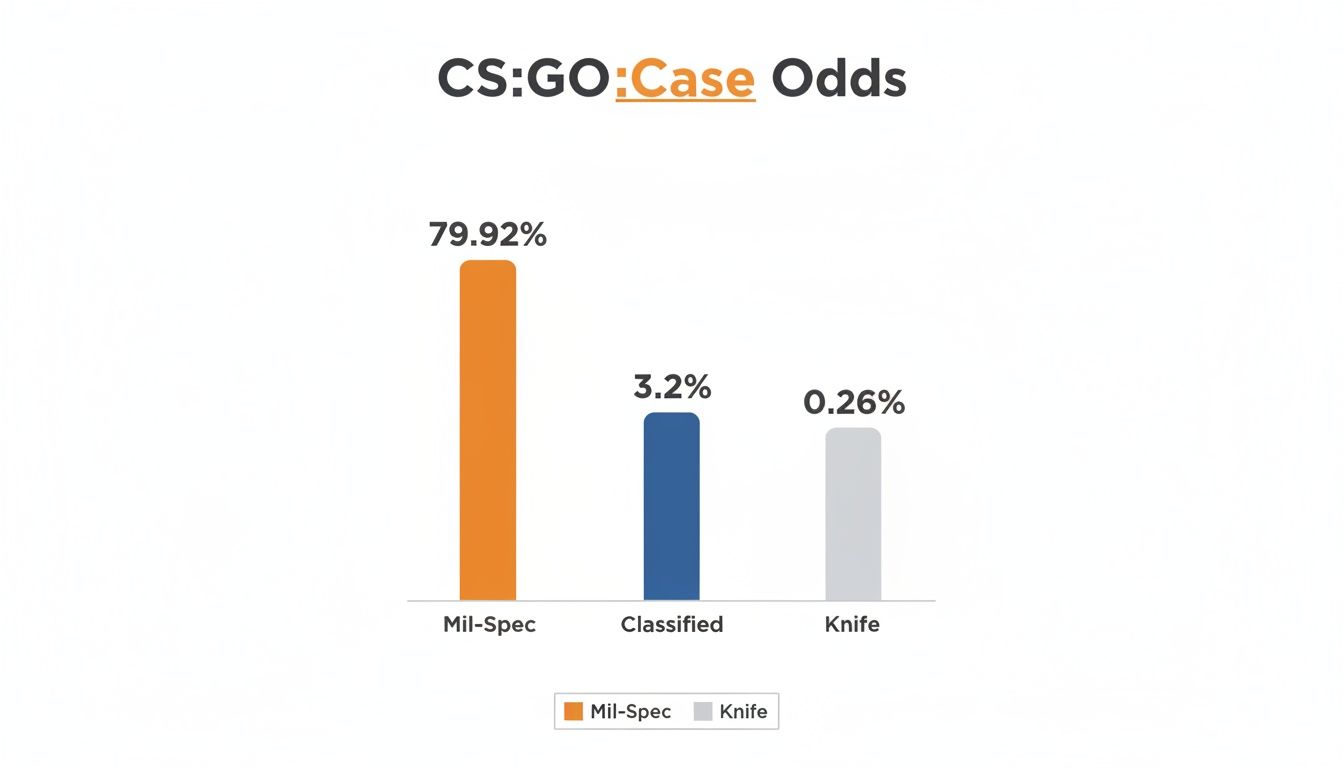
The exponential decrease in probability from common to rare items highlights the low likelihood of receiving a high-value drop.
Rarity Tiers and Their Probabilities
These case opening probabilities are fixed and do not vary between different cases. The only variable is the specific collection of skins contained within each case.
Key Insight: A Kilowatt Case and a Dreams & Nightmares Case possess the identical 0.26% probability of dropping a Gold item. The distinction lies in the potential market value of that specific drop.
The official breakdown of rarity tier chances for every standard weapon case in CS2 is detailed below.
Official CS2 Case Rarity Drop Rates
| Rarity Tier | Official Drop Rate | Approximate Chance |
|---|---|---|
| Mil-Spec (Blue) | 79.92% | 1 in 1.25 cases |
| Restricted (Purple) | 15.98% | 1 in 6 cases |
| Classified (Pink) | 3.2% | 1 in 31 cases |
| Covert (Red) | 0.64% | 1 in 156 cases |
| Exceedingly Rare (Gold) | 0.26% | 1 in 385 cases |
These figures are the foundation of the CS2 skin economy. This data allows for an objective analysis of the risk and potential value associated with opening cases.
Understanding these base odds is the first step. Additional probability layers, including StatTrak™ versions and item wear conditions, further influence an item's final value.
Understanding StatTrak™ and Item Condition Probabilities
The base rarity drop rates are only the first of three probability layers. The presence of a StatTrak™ modifier and the skin’s condition significantly alter an item's rarity and market price. Understanding these variables is key to grasping the true case odds csgo presents.
A flat 10% chance exists for any unboxed weapon skin to be a StatTrak™ version. This probability is constant across all rarity tiers, making any StatTrak™ skin nine times rarer than its non-StatTrak™ counterpart.
This modifier divides the probability for each rarity tier. Using the 0.64% chance for a Covert skin as an example:
- Standard Covert: 0.576% chance
- StatTrak™ Covert: 0.064% chance
These unboxing statistics demonstrate how quickly a rare item becomes exceptionally rare. The probability of obtaining a StatTrak™ knife drops to 0.026%, or approximately one in every 3,850 cases.
The Impact of Item Condition and Float Value
The next layer of probability is the skin's condition, determined by its float value. This number, ranging from 0.00 to 1.00, assigns a condition from Factory New to Battle-Scarred. The distribution of these conditions is not uniform.
Warning: A common misconception is that all wear conditions have an equal probability. In reality, each skin has a defined float range, with odds often skewed toward mid-tier conditions like Field-Tested.
Each skin is programmed with a minimum and maximum possible float value. Many skins have a range that does not span the entire 0.00-1.00 spectrum, meaning some conditions are impossible to obtain for certain items.
The AK-47 | Redline acts as a prime example. Its float is restricted to between 0.10 and 0.70, making a Factory New version impossible to unbox. This mechanic directly impacts market dynamics, proving that rarity tier chances are merely the starting point for valuation.
The combination of these three independent probabilities, rarity, StatTrak™, and condition, creates a complex system. This layered RNG is why StatTrak™ Factory New skins are among the most valuable assets in the CS2 economy.
How to Calculate the Expected Value of a CS2 Case
Knowledge of drop rates is foundational, but translating those odds into financial metrics is what defines a sophisticated approach. Expected Value (EV) is a statistical calculation that predicts the average financial outcome of opening a single CS2 case over a large number of trials.
EV provides an objective measure of long-term profitability. A positive EV suggests a theoretical profit over many openings, while a negative EV indicates a statistical certainty of financial loss over time.
A Step-by-Step Guide to Calculating Case EV
The formula requires two primary inputs: the probability of each potential drop and its current market value.
- List All Potential Drops: Enumerate every possible skin from the case, from Mil-Spec to Exceedingly Rare items.
- Find Current Market Prices: Obtain current values for each skin. Use reliable third-party markets like CSFloat or BUFF Market for accurate data, as Steam Market prices can be inflated.
- Multiply Price by Probability: For each skin, multiply its market value by its drop probability. For example, a $5 Classified skin (3.2% probability) contributes $0.16 to the total EV ($5 * 0.032).
- Sum All Weighted Values: Add the results from step three for all items in the case. This sum represents the gross expected value.
- Subtract Opening Costs: From the gross EV, subtract the total cost of opening the case, which includes the case price plus the key price (approximately $2.50).
The final number is the net EV. A result of -$1.10 signifies a statistically expected loss of $1.10 per case opening.
The Financial Reality of Unboxing
Analysis reveals that nearly all CS2 cases possess a negative net expected value.
Critical Warning: The overwhelming majority of CS2 cases have a negative expected value. This makes case opening an unprofitable activity from a financial investment standpoint. You are statistically guaranteed to lose money over a large sample size.
This calculation is the most effective tool for managing financial expectations. It provides mathematical proof that direct acquisition of skins is a more sound financial strategy than attempting to unbox them. For a comparison of containers with slightly better returns, see our guide on the best CS 2 cases to open.
Why Case Supply Changes Everything
The official case odds csgo players know are only one component of an item's value. The supply of a specific case is an equally critical factor that influences the market price of its contents.
CS2 cases are categorized into two pools, which determines their supply and long-term price trajectory.
Active vs. Rare Drop Pools
Most cases belong to the Active Drop Pool. These are awarded weekly through gameplay, resulting in a massive and constantly replenished supply. Consequently, their market price is typically very low.
Conversely, the Rare Drop Pool contains discontinued cases that no longer drop in-game. Their supply is finite. As existing cases are opened, the total number in circulation decreases, causing the price of the sealed container to increase significantly.
This economic principle means the case's scarcity can have a greater impact on a skin's price than its unboxing statistics. A Mil-Spec skin from a rare case can often be more valuable than a Covert skin from an active case.
Example: The Operation Hydra Case
Operation-specific cases illustrate how limited supply creates value. They are available only for the duration of an operation, after which their supply becomes fixed.
Market Insight: A skin's value is a function of its unboxing probability and its case's scarcity. A common item from a rare case can outperform a rare item from a common case in terms of market value.
The Operation Hydra Case, released in 2017, is a prime example. The supply was permanently capped after the operation concluded. This scarcity has driven its price above $50 per case.
The high cost of the container increases the floor price of every skin within it, including the AWP | Oni Taiji. This supply-side factor is essential for anyone evaluating skins for long-term investment. Monitor the newest CS 2 cases to identify potential future collectibles.
Debunking Common Myths About Case Odds
Misinformation about CS2 case odds is widespread, often stemming from a desire to find a strategy to overcome random chance. These beliefs are based on a misunderstanding of how probability functions.
The system is governed by impartial code. Each time a case is opened, a pseudorandom number generator (PRNG) on the server determines the outcome. This process is memoryless; past results have no influence on future ones.
Myth 1: Timing Your Openings Matters
A prevalent myth suggests that opening cases at specific times or under certain server conditions improves drop rate percentages. This is false. The server's PRNG is indifferent to external factors like time of day or server population.
The probability of receiving an Exceedingly Rare item remains fixed at 0.26%. Perceived patterns are the result of confirmation bias, where one remembers successes that align with a theory and disregards the more numerous failures.
Myth 2: Opening Cases in Bulk Increases Luck
Another common misconception is that opening many cases simultaneously improves outcomes. While opening 400 cases creates a high statistical likelihood of receiving a gold-tier item, it does not guarantee it.
Each opening is an independent event with a 1 in 385 probability. The system contains no "pity timer" or mechanic that increases odds based on volume. The rarity tier chances reset for every individual opening.
The Gambler's Fallacy: This is the cognitive bias that a particular outcome is "due" after a long streak of other outcomes. In CS2, a series of poor unboxings does not increase the probability of a high-value drop. The odds are static.
Myth 3: Certain Accounts Are "Luckier"
The idea that Valve grants better odds to new accounts, high-level Steam profiles, or accounts with valuable inventories is baseless. Valve's system is designed to be impartial to prevent manipulation.
An account's age, trust factor, rank, or inventory value has no effect on the unboxing algorithm. The case opening probabilities are hardcoded and apply equally to all players. For those seeking skins without relying on chance, our guide on how to get /free-cs2-skins details legitimate acquisition methods.
Responsible Unboxing and Safer Alternatives
Understanding the unfavorable mathematics behind case odds csgo is the first step toward responsible participation. Case opening is a form of gambling where the operator (Valve) has a statistical advantage. The only logical approach is to treat it as an entertainment expense with a pre-determined budget.
If you want skin-economy odds you can actually compute in advance, trade up contracts are the alternative: ten skins of one rarity become one of the next tier, with exact probabilities determined by your inputs rather than a hidden drop table. Our CS2 trade up calculator shows the odds, output floats and expected value of any contract at live prices, including which contracts are profitable right now.
Disclaimer: CS2 gambling and case opening involve real money and risk. Only gamble what you can afford to lose. Must be 18+ or the legal age in your jurisdiction. If you have gambling problems, visit BeGambleAware.org.
The negative expected value confirms that unboxing is not a viable investment strategy. On average, the return is less than the cost. Attempting to unbox a specific high-tier skin is the most expensive and inefficient method of acquisition.
Prioritizing Direct Acquisition Over Chance
The most cost-effective and efficient way to obtain a desired skin is to purchase it directly. Bypassing the RNG of case opening guarantees you receive the exact item you want without wasting funds on low-tier skins.
Platforms such as DMarket and Skinport offer large inventories and competitive pricing. Our verified list of the best CS2 trading sites features platforms known for security and user protection. This method eliminates all gambling risk.
Making Informed Choices
For those who choose to open cases for entertainment, platform selection is critical. Only use sites that are well-regarded and employ provably fair systems to ensure transparent and unaltered odds.
- Set Strict Limits: Establish a budget before you begin and adhere to it strictly.
- Never Chase Losses: A streak of negative outcomes does not increase the probability of a win. Each opening is an independent event.
- Know When to Stop: If the activity is no longer enjoyable, cease participation.
Our team has reviewed numerous platforms to identify those with strong reputations and transparent operations. Our findings are available in the best CS2 gambling sites reviews. Also, review our guide on responsible gambling to understand safe practices.
Frequently Asked Questions About Case Odds
This section provides data-backed answers to common questions regarding CS2 case odds.
Q: What are the exact odds of unboxing a knife in CS2?
A: The official probability of unboxing an "Exceedingly Rare Special Item," which includes knives and gloves, is 0.26%. This figure is based on Valve's own disclosure. Statistically, this translates to an average of one special item for every 385 cases opened.
Q: What is the average cost to unbox a knife?
A: Based on the 0.26% drop rate, the average cost to unbox a knife is approximately $962.50. This calculation assumes a combined case and key cost of $2.50 multiplied by the 385 cases needed on average. Purchasing a specific knife directly from one of the best CS2 trading sites is consistently more cost-effective.
Q: Do third-party case opening sites offer better odds?
A: No, reputable third-party sites use the same 0.26% odds for top-tier items. Unregulated platforms may manipulate their probabilities. It is critical to use platforms that feature a "Provably Fair" system to ensure transparency. Vetted platforms can be found in our best CS2 gambling sites reviews.
Q: How do I verify if a third-party site is fair?
A: A trustworthy site must have a "Provably Fair" system. This cryptographic method allows users to independently verify that an outcome was random and not manipulated. The process uses a combination of a server seed, a client seed, and a nonce to generate a result that can be mathematically replicated for verification. Avoid any site that does not offer this feature.
Q: Is it more profitable to sell cases or to open them?
A: Selling cases is always more profitable. Selling cases on a marketplace like the Steam Market or BUFF Market provides a guaranteed, albeit small, profit. Opening cases has a negative expected value, ensuring a statistical loss over time. From a financial perspective, selling cases is the only logical strategy.