The price of a CS2 knife is determined by a combination of rarity, wear, model, and pattern. A knife's value ranges from under one hundred dollars to over $1,500,000 for a rare item like a Factory New Karambit | Case Hardened (Blue Gem).
Understanding these core price drivers is the first step to making informed trades and avoiding costly mistakes.
Decoding the Key Drivers of CS GO Knife Prices
A CS2 knife’s market value is the direct result of several key attributes. Each factor contributes to the item's scarcity and desirability, creating the complex pricing structure seen on marketplaces. The most fundamental elements are the knife model and the rarity of its finish.
Certain models possess greater inherent demand. Knives like the Butterfly Knife or Karambit command higher prices due to their unique animations and popularity. This establishes a higher price floor compared to less popular models like the Navaja or Shadow Daggers. Rarity tiers, such as Covert (red), also set a baseline value before other factors are considered.
Float Value and Wear Levels
The most significant price modifier is the float value, a numerical representation of an item's wear on a scale from 0.00 to 1.00. A lower float indicates a cleaner appearance and results in a higher market value.
Float values are categorized into five primary wear levels:
- Factory New (FN): 0.00 – 0.07
- Minimal Wear (MW): 0.07 – 0.15
- Field-Tested (FT): 0.15 – 0.38
- Well-Worn (WW): 0.38 – 0.45
- Battle-Scarred (BS): 0.45 – 1.00
A Factory New Karambit | Doppler can trade for thousands of dollars, while its Battle-Scarred equivalent may be worth only a fraction of that amount. Higher wear levels introduce visible scratches and faded paint, which reduces visual appeal and value.
Special Attributes and Pattern Indexes
Beyond wear, two attributes cause significant price variations: StatTrak™ technology and rare patterns. A StatTrak™ knife, which tracks in-game kills, is rarer than its non-StatTrak counterpart and consistently carries a price premium.
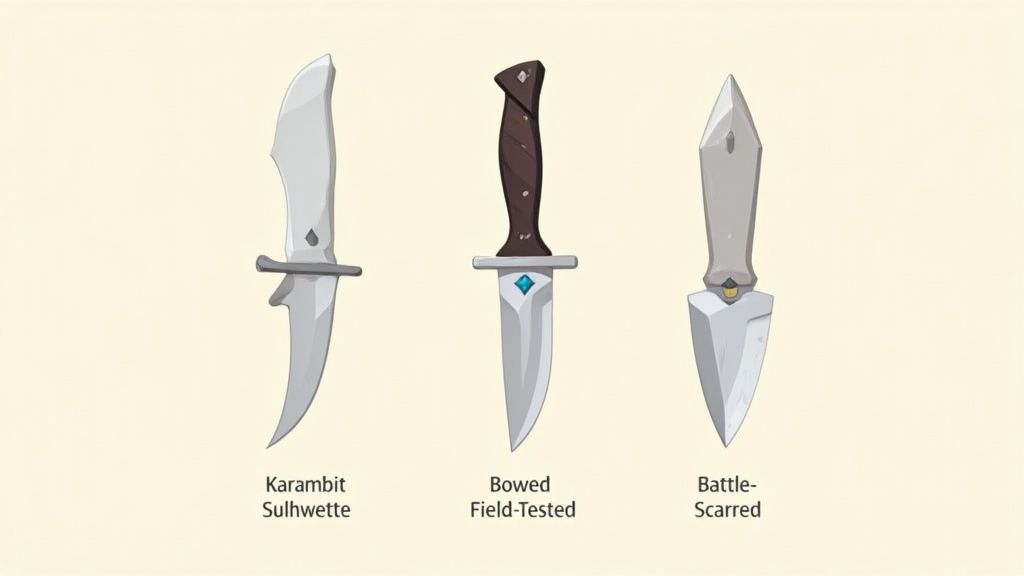
Community-tracked data from sites like CSGOStash demonstrates how finishes like "Doppler" or "Marble Fade" occupy a different price tier than a more common "Forest DDPAT" finish on the same knife model.
Pattern indexes are another critical value determinant for specific finishes. For skins like Case Hardened or Doppler, the visual pattern can dramatically alter its value. A Case Hardened skin with a high concentration of blue becomes a "Blue Gem," increasing its worth exponentially. The rifle version follows the same logic, our AK-47 Case Hardened blue gem breakdown shows which pattern indexes command the biggest premiums. Similarly, Doppler finishes have rare "Phases" like Sapphire, Ruby, and Emerald that are far more valuable than standard patterns.
The following table summarizes the primary factors that influence CS2 knife prices.
Knife Price Influencers At a Glance
| Factor | Description | Price Impact |
|---|---|---|
| Knife Model | The type of knife (e.g., Karambit, M9 Bayonet). | High: Popular models with unique animations have a much higher base price. |
| Finish/Skin Rarity | The rarity tier of the skin (e.g., Covert, Classified). | High: Higher tiers from rarer cases establish a higher price floor. |
| Float Value (Wear) | A 0.00-1.00 scale measuring visible wear. | Very High: Lower floats (Factory New) are exponentially more valuable. |
| StatTrak™ | An in-game counter that tracks kills. | Medium: Adds a premium over the non-StatTrak version due to rarity. |
| Pattern Index | Unique visual patterns on skins like Case Hardened or Doppler. | Extreme: Rare patterns like "Blue Gems" or "Sapphires" can multiply a knife's value. |
A firm grasp of these factors is essential for any trader. They determine whether a knife is a common item or a high-value collector's piece.
How to Analyze Market Data and Liquidity
Evaluating knife prices requires more than knowledge of wear and patterns. Serious traders must analyze market data and liquidity. It is key to study price history charts on platforms like CSFloat or BUFF Market to identify trends, support levels, and resistance points. These metrics provide signals for optimal buying and selling times.
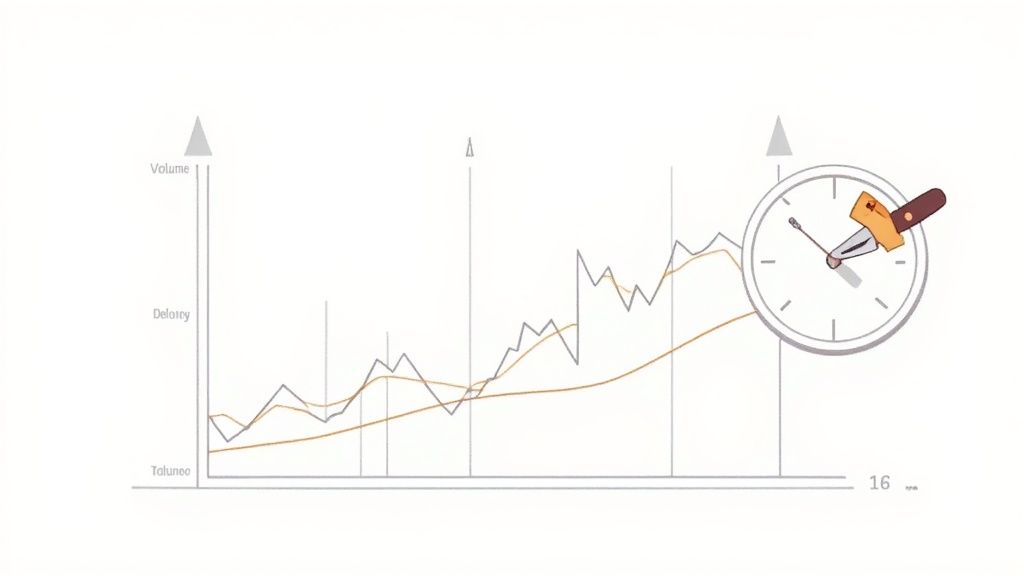
These charts illustrate an item’s value fluctuation over weeks, months, or years. Look for consistent price floors (support) where the value repeatedly stops declining, and price ceilings (resistance) where it struggles to increase. This historical data provides a framework for forecasting future price movements.
Interpreting Liquidity and Sales Volume
Beyond price charts, liquidity is a critical metric for traders. It measures how quickly an item can be sold at its current market price without negatively impacting its value.
High liquidity indicates strong, consistent demand from buyers, allowing for fast transactions. Low liquidity signals a stagnant market where an item may take weeks to sell or require a significant price reduction.
Safety Note: Always use reputable platforms with secure payment methods. Never share your Steam login credentials or API keys with third parties.
Practical Data Analysis
When analyzing a knife's market page, focus on two key data points: the number of active listings and recent sales frequency. A large volume of listings with few daily sales suggests an over-saturated, low-demand market and is a negative indicator.
Conversely, few active listings combined with high daily sales volume indicates scarcity and strong buyer interest. This scenario often precedes a price increase. Some platforms, like Tradeit.GG, offer built-in analytical tools. Our in-depth review of Tradeit.GG details how its interface presents these key metrics to enable faster decision-making.
For the most accurate assessment, compare these numbers across several top-tier marketplaces. This multi-platform approach helps identify market-wide trends and avoid being misled by price anomalies on a single site. For a complete list of verified platforms, see our guide on the <a href="/best-cs2-trading-sites">best CS2 trading sites</a>.
Comparing the Top Marketplaces for Knife Trading
The choice of trading platform directly impacts profitability. While the Steam Community Market is the official venue, its 15% transaction fee and lack of real-money cash-out options make it unsuitable for serious traders.
Consequently, most high-value knife trading occurs on third-party marketplaces. These platforms offer lower fees, direct bank withdrawals, and larger inventories. Understanding the operational differences between them is key for securing the best deals and ensuring asset safety.
Fee Structures and Transaction Models
The primary distinction between platforms lies in their fee structures and transaction models. Some, like Skinport, use a traditional consignment model where users list items and wait for a buyer. Others, like CSFloat, operate on a peer-to-peer (P2P) basis, directly connecting buyers and sellers.
- Sales Fees: Skinport charges a 12% fee on items under $1,000, which drops to 6% for more expensive knives.
- P2P Fees: P2P platforms are typically more cost-effective. CSFloat charges sellers a 2% fee, which is highly advantageous for frequent traders.
- Cash-Out Fees: Withdrawal fees vary based on country and payment service. Always verify these costs before committing to a sale.
Note: Prices and fees are subject to change. Always verify current rates on the platform's official website before trading.
Comparing Top Platform Features
Selecting the right marketplace depends on individual trading style and volume. Traders must often weigh lower fees against factors like user experience or buyer pool size. For a detailed, updated comparison, refer to our guide to the best CS2 skin trading sites.
The following table provides a concise breakdown of the leading knife trading platforms.
Third-Party Marketplace Fee and Feature Comparison
| Platform | Sales Fee | Transaction Type | Best For |
|---|---|---|---|
| Skinport | 6% – 12% | Traditional Marketplace (Consignment) | Sellers who want a simple, hands-off experience with lots of buyers. |
| CSFloat | 2% | Peer-to-Peer (P2P) | High-volume traders and buyers hunting for the absolute lowest fees. |
| BUFF Market | 2.5% | Peer-to-Peer (P2P) | Traders with access to Chinese payment methods seeking huge liquidity. |
The fee differences alone can significantly alter the potential profit on a single high-value knife transaction.
Security and User Base Considerations
Security is essential when dealing with high-value digital items. The platforms listed above use trade escrow or browser extensions for P2P transactions to ensure trades are completed securely.
The size and geographic concentration of a platform's user base also influence trading. BUFF Market has the highest volume but is less accessible for Western users due to its payment systems. Skinport and CSFloat host large international communities, ensuring a consistent market for a wide variety of knives.
Actionable Strategies for Finding Undervalued Knives
Identifying undervalued knives requires a systematic approach, not luck. Automating the search is the most effective first step. A tool like our <a href="/cs2-deals-bot">CS2 deals bot</a> monitors dozens of marketplaces simultaneously, providing instant alerts when an item is listed below its market rate.
This automation provides a critical speed advantage, enabling users to acquire deals moments after they are listed. Alerts can be customized for specific knives, finishes, and float value ranges, which is effective for catching listings from sellers unaware of an item's rare pattern or low float.
Identifying Hidden Value in Listings
The most significant deals are often found in attributes that most traders overlook. Many sellers price items based on the general "Factory New" designation, but the specific float number holds hidden value. A low-float Minimal Wear knife can appear identical to a Factory New one while selling for a lower price.
Searching for these "best-in-wear" items is a sound strategy for acquiring premium-looking skins at a discount. Key opportunities include:
- Low-Float Knives: A Minimal Wear knife with a float between 0.07-0.08 is often visually indistinguishable from Factory New.
- Overlooked Patterns: Sellers may not recognize a top-tier Case Hardened pattern or a high fade percentage on a Marble Fade skin. Learn to spot a valuable AK-47 blue gem pattern before you buy so you can flip an underpriced listing.
- "Dirty" Finishes: On certain skins, like those from the Prisma 2 Case, a high-float Battle-Scarred version can have a unique "blacked out" appearance that creates niche demand. Our guide to the Prisma 2 Case knife collection explores these quirks.
This flowchart illustrates a typical progression for a trader seeking deals across different platforms.
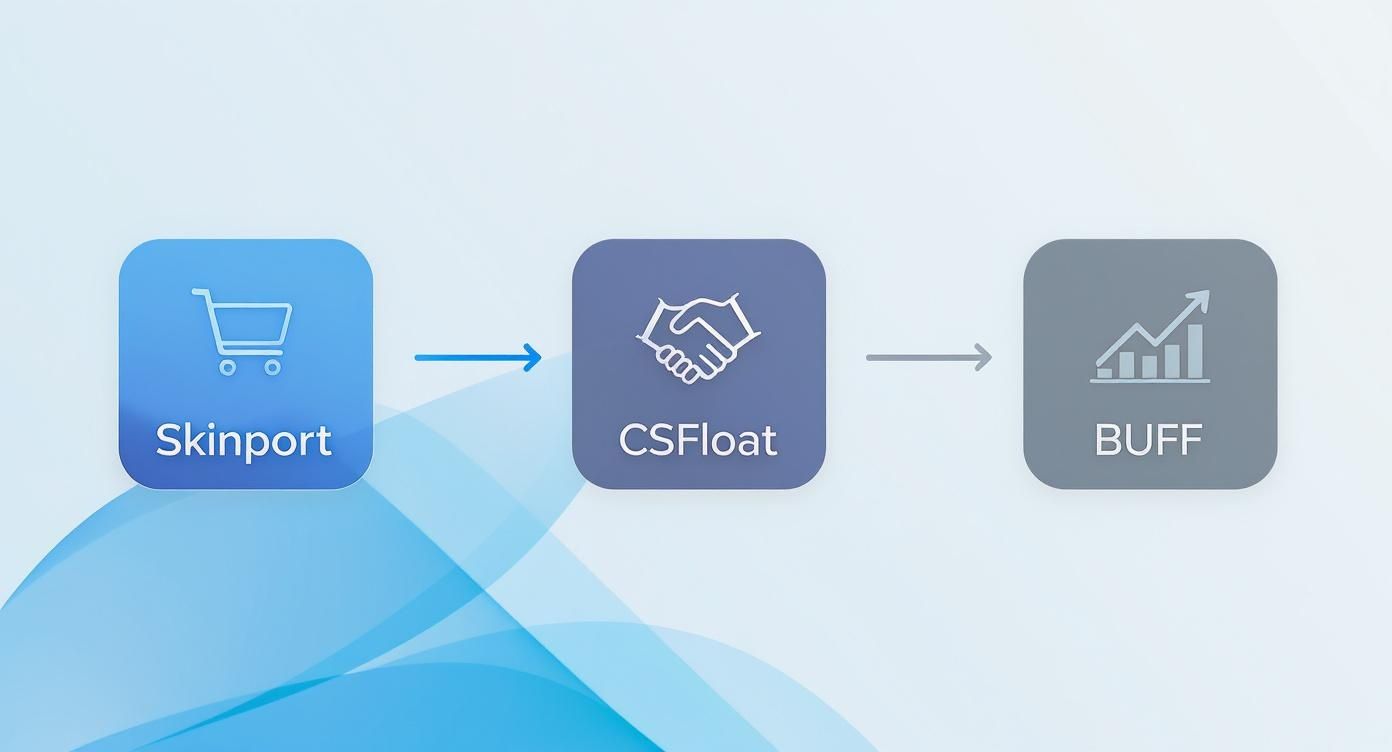
The path begins with straightforward storefronts like Skinport, moves to P2P markets like CSFloat, and progresses to high-volume platforms like BUFF, reflecting increasing trader experience.
Mastering Peer-to-Peer Negotiation
Negotiation is an expected practice on P2P sites like CSFloat. Many sellers list items with a price buffer, anticipating offers below their initial asking price. When submitting an offer, support it with recent sales data rather than just citing the lowest current listing.
Key Insight: Patience and research are fundamental to successful trading. Rushed purchases made out of excitement often lead to overpayment. The most successful traders wait for optimal opportunities.
When making an offer, be professional and provide evidence. Reference the 7-day sales average for the specific float range. An offer that is 5-10% below the asking price is generally considered reasonable and can initiate a productive negotiation, resulting in a better price than the listed one.
Understanding Broader Market Trends and Price Indexes
Analyzing individual knife prices is only one component of a successful trading strategy. A complete approach requires understanding the broader CS2 skin economy. This is analogous to the stock market, where one examines major indexes like the S&P 500 to gauge overall market health, not just individual stocks.
Price indexes serve this function for the skin market. They track the collective value of hundreds of knives, providing a clear signal of market sentiment. This high-level view is key, as broad market trends affect the value of nearly all items.
Reading the Market's Pulse
Price indexes are essential tools for identifying macroeconomic trends. They aggregate data from numerous sources to create a "basket" of knives, displaying the total value across all wear conditions. This perspective prevents traders from being misled by the volatility of a single item.
Historically, the value of knives tends to appreciate over time due to their fixed rarity. However, significant price spikes are often linked to major game updates or announcements. These shifts can be tracked on platforms like Skinflow.gg.
This historical price index for a collection of CS2 knives illustrates moments of significant growth and consolidation.
The dramatic surge in early 2023 corresponds with the CS2 announcement, which caused a market-wide frenzy and a rapid increase in the value of nearly all knives.
What Makes the Whole Market Move?
The CS2 knife market is influenced by external events that can cause rapid, widespread price shifts. Awareness of these catalysts allows traders to anticipate market movements.
The three primary market drivers are:
- Major Game Updates: The release of a new case introduces fresh supply. Players often sell older knives to purchase keys, which can temporarily depress prices. Conversely, a significant gameplay update that increases the player base boosts demand and drives prices up.
- Esports Events: During a CS2 Major tournament, community engagement peaks. This excitement often translates to increased market activity and rising prices, particularly for skins used by professional players.
- Seasonal Trends: The market follows a cyclical pattern. Prices tend to increase during summer and winter holidays when player activity is high. They may dip during quieter periods when school is in session or during vacation seasons.
Key Takeaway: Successful traders anticipate market trends by monitoring the entire CS2 scene. Following official game news and the esports calendar provides a significant strategic advantage.
Combining micro-level analysis of individual items with a macro-level understanding of market forces enables strategic trading. This is the distinction between speculation and informed investing.
Knife Trade Ups Changed the Market
Since the October 2025 update, knives are no longer exclusively a case drop: a trade up contract of five Covert skins now returns a knife or gloves from those skins' case pools. That single change repriced the whole knife market, Covert skins rose as contract fodder while many knives fell, so treat any pre-update price guide with caution. Before buying a knife outright, it's worth checking whether crafting one is cheaper: our CS2 trade up calculator prices every knife outcome of a contract with live odds, float and market data.
CS2 Knife Prices: FAQ
This section answers the most common questions about CS2 knife prices, based on market data and trading experience.
Q: Can you make a profit trading CS2 knives?
A: Yes, profitable trading is possible but requires strategy and patience. Profit is generated by identifying undervalued items, such as knives with low floats or rare patterns listed at floor price, and selling them for their true market value. Profit margins can range from 5% to over 50% for rare finds. This is an active effort, and losses are possible if one buys at a market peak or lacks knowledge of value factors.
Q: What is the cheapest knife available in CS2?
A: The most affordable entry-level knives are typically the Navaja Knife, Shadow Daggers, or Gut Knife. The lowest prices are found on less desirable finishes like Safari Mesh or Boreal Forest in Battle-Scarred condition. On third-party marketplaces such as CSFloat or BitSkins, these knives can often be purchased for between $60 and $85.
Q: How much does float value affect a knife's price?
A: Float value has an exponential impact on price, particularly as it approaches 0.00. A standard Factory New knife (float 0.00-0.07) can be worth two to ten times more than its Field-Tested version (float 0.15-0.38). For example, a Butterfly Knife | Case Hardened (Factory New) may be valued at $2,500, while the same knife in Field-Tested condition could drop to $1,800. For collectors, an ultra-low float (<0.001) commands a significant premium.
Q: Why are knife prices different across various marketplaces?
A: Price discrepancies exist due to several factors. Seller fees on platforms like Skinport (6-12%) are higher than on CSFloat (2%), prompting sellers to list items at higher prices to achieve their desired net payout. Also, regional user bases, like on BUFF Market, create unique supply and demand dynamics. Always compare prices across several top platforms before making a purchase.
Q: How can I avoid scams when trading knives?
A: Reputable marketplaces and secure P2P systems mitigate most direct scams. The primary risk is a "bait-and-switch" attempt, where a scammer offers an item that looks similar to a more valuable one (e.g., a Doppler Phase 1 instead of a Sapphire). Before accepting any trade, verify the exact wear rating (float), pattern index, and finish name in the inspection window. Using a trusted browser extension from a platform like CSFloat can also provide detailed item verification within the trade interface.
Set up our CS2 deals bot to track prices automatically. It scans over 50 marketplaces 24/7 and sends instant alerts, ensuring you can act on the best deals before they disappear.